
The Short Answer
Hyaluronidase is an enzyme used to dissolve hyaluronic acid (HA) fillers such as Juvéderm and Restylane. It can be extremely useful for treating misplaced or excessive filler, persistent swelling and the blue-gray discoloration known as the Tyndall effect. But the presence of residual filler on ultrasound or MRI does not necessarily mean that every trace of it needs to be removed. The goal should be correction of the clinical problem—not simply elimination of an imaging finding. In many cases, selective hyaluronidase treatment followed by careful massage and reassessment can produce a better aesthetic result than repeatedly attempting to dissolve every detectable molecule of filler.
Hyaluronidase dissolves hyaluronic acid–based fillers by hydrolyzing the HA polymer — breaking it down so the body can clear it. Recent literature has challenged even the terminology of “dissolving” filler. Harris and Weiner argue that hyaluronidase may be better understood as modifying a complex filler-tissue system rather than predictably eradicating every molecule of HA. Importantly, clinical improvement may occur even when ultrasound or MRI continues to demonstrate residual filler.1
Key Takeaways
- Hyaluronidase can selectively dissolve unwanted hyaluronic-acid filler.
- Tyndall effect is a blue-gray discoloration that can occur when HA filler is placed too superficially.
- Not every residual pocket of filler visible on ultrasound or MRI requires treatment.
- Repeated attempts to eliminate every trace of filler may create additional swelling, tissue changes and dissatisfaction.
- Clinical examination should determine whether detected filler is actually causing an aesthetic problem.
- In selected cases, careful massage and molding after hyaluronidase can be an important part of correction.
Hyaluronic acid fillers such as Juvéderm and Restylane can produce beautiful results—and when they don’t, hyaluronidase can often correct the problem remarkably well.
But somewhere along the way, “dissolving unwanted filler” has evolved into something quite different: a quest to hunt down and eradicate every detectable trace of filler from the face.
And I think we need to talk about it.
Unless you have been living in a hermetically sealed cave for the past 20 years, you have probably heard of hyaluronic acid (HA) fillers such as Juvéderm and Restylane.
Hyaluronic acid itself is hardly an exotic substance. It is a naturally occurring sugar found throughout the human body—in our skin, connective tissues, joints and even our eyes. Its ability to attract and retain water is one reason HA fillers are so useful for restoring volume, softening contours and reshaping certain areas of the face.
Most of the time, when properly selected and properly injected, they work very well.
But not always.
When Good Filler Goes Bad
Hyaluronic acid is hydrophilic—it attracts water. That is generally useful, but in certain areas, particularly around the eyes, too much filler or filler placed at the wrong depth can create persistent puffiness or edema.
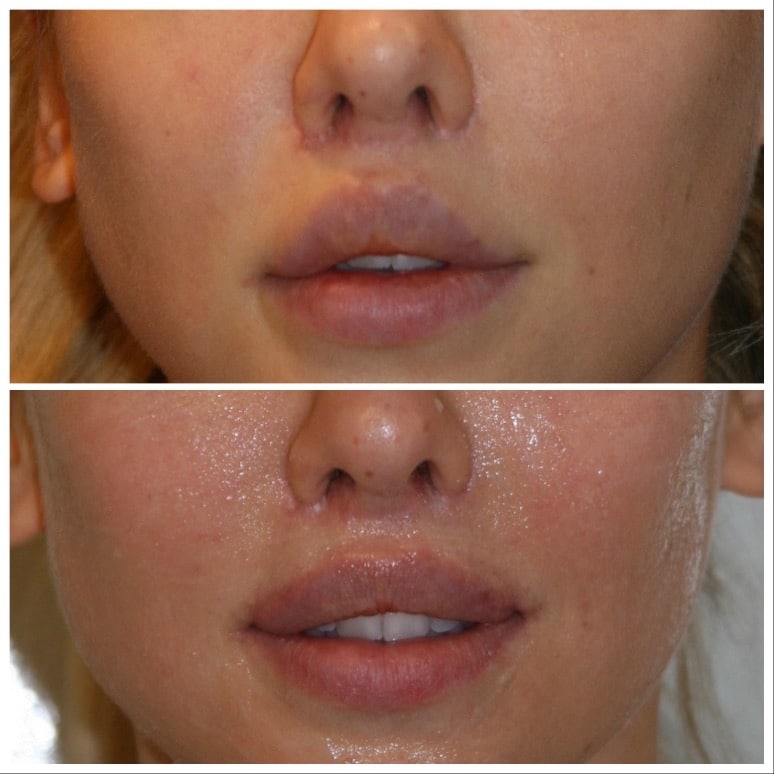
HA filler can also sometimes produce a characteristic bluish-gray discoloration, particularly when placed too superficially. This is commonly referred to as the Tyndall effect.
And frustratingly, these problems don’t necessarily announce themselves while you’re still sitting in the injector’s chair. Swelling, contour irregularities and unwanted fullness can become apparent days or even a week or two later.
Fortunately, HA fillers have one enormous advantage over many other injectable materials:
We have an eraser.

Under-eye Tyndall effect / bag from hyaluronic acid filler (before hyaluronidase).

After hyaluronidase with careful massage and molding.
Before and after treatment of the Tyndall effect. Improvement followed targeted hyaluronidase with careful massage and molding.
Hyaluronidase: The Filler Eraser
Hyaluronidase is an enzyme that breaks down hyaluronic acid. Commercial preparations include products such as Hylenex and Vitrase, among others.
I often describe hyaluronidase to my patients as a pencil eraser.
If I’ve performed a filler treatment and several days later notice a little excess fullness or an area that needs refinement, a carefully placed amount of hyaluronidase can often correct it quickly and effectively.
I also use hyaluronidase before certain facial surgical procedures when previously placed filler is obscuring the anatomy I actually need to evaluate or treat.
Used thoughtfully, it is an extraordinarily useful tool.
The trouble starts when the pencil eraser becomes a belt sander.
The New Obsession With Dissolving Everything
Increasingly, I see patients who don’t simply want an unattractive area of filler corrected.
They want every molecule of filler removed from their face.
Some arrive after months of repeated dissolving sessions. They have undergone ultrasounds, MRIs or other imaging studies searching for residual pockets of filler.
A scan identifies another tiny area.
That area gets injected with more hyaluronidase.
Another scan is obtained.
Something else is found.
And down the rabbit hole we go.
More appointments. More scans. More dissolving. More swelling. More anxiety. More money.
Yet when I actually look at the patient, there may be very little—or sometimes nothing—visibly wrong.
At some point, the pursuit itself becomes the problem.
Interestingly, this isn’t merely theoretical. A retrospective study of 157 treated orbits found that while 59% achieved a satisfactory result after hyaluronidase, 24% required additional treatment and 18% reported post-treatment facial changes such as hollowing—a phenomenon the authors termed “posthyaluronidase syndrome.” This does not prove that hyaluronidase permanently damages one’s native tissues, as some corners of social media would have you believe. But it does reinforce a rather basic aesthetic principle: more treatment is not necessarily better treatment.3
Hyaluronic Acid Is Not a Metastatic Disease
This is where some perspective is desperately needed.
Residual hyaluronic acid filler is not cancer. It is not a metastatic disease that must be hunted down and banished from every corner of the face.
The objective of aesthetic medicine is not to produce an MRI demonstrating absolute molecular purity.
The objective is to make the patient look better.
That distinction sounds ridiculously obvious.
Apparently, it isn’t.
Imaging can unquestionably be useful. Ultrasound, for example, can help identify the location and depth of previously injected material in selected situations. MRI may reveal material or tissue changes that aren’t obvious on examination.
But the existence of something on an image does not automatically mean that it is producing an aesthetic problem—or that treating it will improve the patient’s appearance.
Which brings me to the sophisticated diagnostic technology I use most frequently.
My Favorite Imaging Device: My Eyes
Patients sometimes ask:
“What makes you successful at dissolving difficult filler? Are you using MRI? Ultrasound? Some special imaging technology?”
Those technologies certainly have their place.
But my primary diagnostic instrument remains decidedly low-tech:
My eyes.
If I see abnormal puffiness, a blue-gray Tyndall effect, contour distortion or meaningful asymmetry that appears related to filler, I treat it.
If I don’t see a problem, I generally leave it alone.
And, perhaps more importantly, I encourage the patient to leave it alone too.
Because I’m treating a face, not an MRI.
An imaging study should help answer a clinical question. It should not automatically create a new clinical problem simply because it detected something.
Hyaluronidase Dissolves. Massage Sculpts.
This isn’t merely philosophical restraint. Published guidance on Tyndall effect specifically describes selective dissolution of the superficial offending HA layer without removing the entire filler deposit. The literature also recognizes massage following hyaluronidase as part of managing certain HA gels. In other words, the objective is correction—not molecular extermination.2
There is another element of successful filler correction that receives surprisingly little attention: massage and molding.
Hyaluronidase is not magic water.
You don’t simply inject a few drops, walk away and wait for perfection to occur.
When appropriate, careful manipulation of the treated area—from deeper tissues toward the surface—can be an important part of achieving a smooth, controlled correction.
In my experience, thoughtful massage and molding can sometimes be every bit as important as where the enzyme itself is placed.
The goal isn’t indiscriminate destruction of filler.
It is controlled correction.
That requires anatomy, judgment, examination and, yes, occasionally knowing when to stop.
Dissolve the Problem—Not the Patient’s Peace of Mind
There is nothing wrong with wanting poorly placed filler corrected. I do it regularly.
There is nothing wrong with using imaging when the clinical situation genuinely warrants it.
And there is certainly nothing wrong with hyaluronidase. It remains one of the great advantages of HA fillers precisely because it gives us a degree of reversibility that many aesthetic treatments simply don’t have.
But there is an enormous difference between correcting a visible problem and embarking upon an endless search for microscopic remnants of something simply because modern imaging technology is capable of finding them.
More information does not always mean more treatment.
Sometimes the most sophisticated decision a physician can make is to look at the patient and say:
“That looks good. Leave it alone.”
In aesthetic medicine, as in much of medicine, the simplest solution is often the best one.
And occasionally, the hardest procedure to perform is no procedure at all.
Selected Medical References
- Harris S, Weiner S. Reframing Hyaluronidase in Aesthetic Medicine: From “Dissolving Filler” to “Modifying Filler.” Aesthetic Surgery Journal. 2026;46(6):NP51–NP54. DOI: 10.1093/asj/sjag022
- Nonvascular Complications of Injectable Fillers—Prevention and Management. https://pmc.ncbi.nlm.nih.gov/articles/PMC7822713/
- The Posthyaluronidase Syndrome: Dosing Strategies for Hyaluronidase in the Dissolving of Facial Filler and Independent Predictors of Poor Outcomes. https://pubmed.ncbi.nlm.nih.gov/38655103/
Randal D. Haworth, MD, FACS
Board-Certified Plastic Surgeon | Beverly Hills



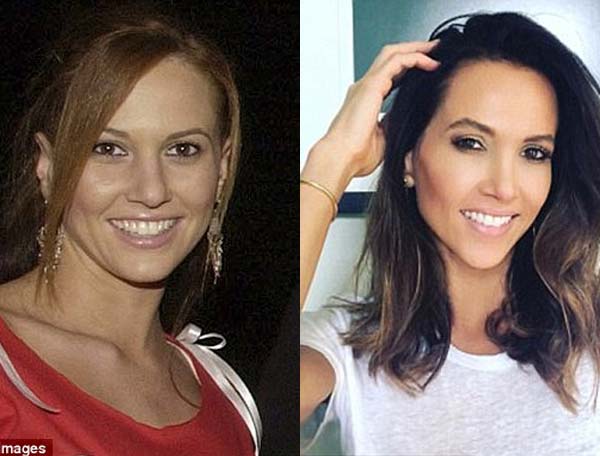 ‘It is amazing what a different hairstyle, well-contoured makeup and perhaps some “photoshopping” can do to make anyone look like a superstar,’ Dr Randal Haworth told Daily Mail Australia on Tuesday. Despite the fact she’s nearing her forties, Dr Haworth recognized how Kyly has undergone a ‘startling transformation’ in recent years.
‘Most people I know would seize the opportunity to look better if given half a chance – and nowadays they can without even stepping foot in a plastic surgeon’s office,’ said Dr Haworth. ‘Her straight brunette hair contributes a good deal to her change (she was formerly blonde) and perhaps deftly applied makeup.’
Dr Haworth noted that while makeup can certainly help change the appearance of facial features, he assumed Kyly’s ‘higher hairline gives a subtle clue’ that she is taking advantage of a simple ‘DIY’ beauty hack.
‘Sometimes Kyly seems to employ the old trick of pulling your hair tightly back into a ponytail for a quick tightening fix of the eyebrows and upper face,’ he said. ‘Even though she looks different, as a hyperaesthetic plastic surgeon, I feel that Kyly looks great.’
‘It is amazing what a different hairstyle, well-contoured makeup and perhaps some “photoshopping” can do to make anyone look like a superstar,’ Dr Randal Haworth told Daily Mail Australia on Tuesday. Despite the fact she’s nearing her forties, Dr Haworth recognized how Kyly has undergone a ‘startling transformation’ in recent years.
‘Most people I know would seize the opportunity to look better if given half a chance – and nowadays they can without even stepping foot in a plastic surgeon’s office,’ said Dr Haworth. ‘Her straight brunette hair contributes a good deal to her change (she was formerly blonde) and perhaps deftly applied makeup.’
Dr Haworth noted that while makeup can certainly help change the appearance of facial features, he assumed Kyly’s ‘higher hairline gives a subtle clue’ that she is taking advantage of a simple ‘DIY’ beauty hack.
‘Sometimes Kyly seems to employ the old trick of pulling your hair tightly back into a ponytail for a quick tightening fix of the eyebrows and upper face,’ he said. ‘Even though she looks different, as a hyperaesthetic plastic surgeon, I feel that Kyly looks great.’
 CEO of DrHaworth.com told Daily Mail Australia: ‘Erin has opted for a “less is more” approach in regards to maintaining and enhancing her facial appearance. This is often the wisest choice for those who make their living in front of the camera.’
 ‘I am quite confident she has neither changed her nose nor augmented her cheeks or jawline. However, her face does seem more elegantly defined perhaps with the help of a little makeup alongside a loss of ‘baby fat’,’ stated the Beverly Hills surgeon.
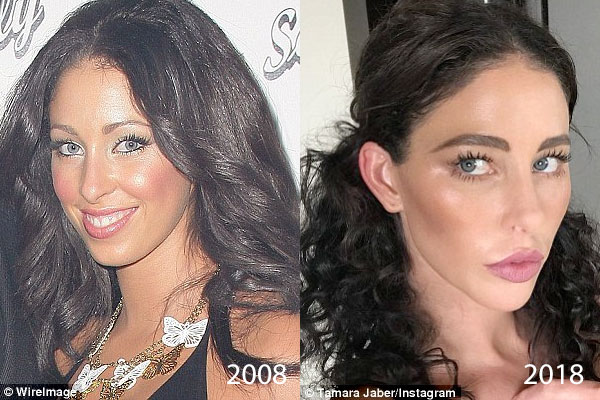 Tamara Jaber, the ex-wife of Kyle Sandilands debuted a dramatic new look during an appearance on The Morning Show last week. She has stayed quiet on the subject of cosmetic procedures. Dr. Haworth, a Beverly Hills plastic surgeon believes her changing look may be the result of a little nip and tuck. Haworth told The Daily Mail ‘I believe Miss Jaber has followed what many do when coming to Hollywood in search of change, whether in their personal or professional lives. And that is to seek out the services of a plastic surgeon’
Dr Haworth claimed that Tamara may have had surgery to refine the shape of her nose. ‘It does not take a hyperaesthetic specialist such as myself to ascertain she has undergone a rhinoplasty,’ Haworth said. Haworth also claimed that her elevated and refined cheeks, fuller lips and noticeably defined jawline have contributed to her overall facial transformation.
Tamara Jaber, the ex-wife of Kyle Sandilands debuted a dramatic new look during an appearance on The Morning Show last week. She has stayed quiet on the subject of cosmetic procedures. Dr. Haworth, a Beverly Hills plastic surgeon believes her changing look may be the result of a little nip and tuck. Haworth told The Daily Mail ‘I believe Miss Jaber has followed what many do when coming to Hollywood in search of change, whether in their personal or professional lives. And that is to seek out the services of a plastic surgeon’
Dr Haworth claimed that Tamara may have had surgery to refine the shape of her nose. ‘It does not take a hyperaesthetic specialist such as myself to ascertain she has undergone a rhinoplasty,’ Haworth said. Haworth also claimed that her elevated and refined cheeks, fuller lips and noticeably defined jawline have contributed to her overall facial transformation.
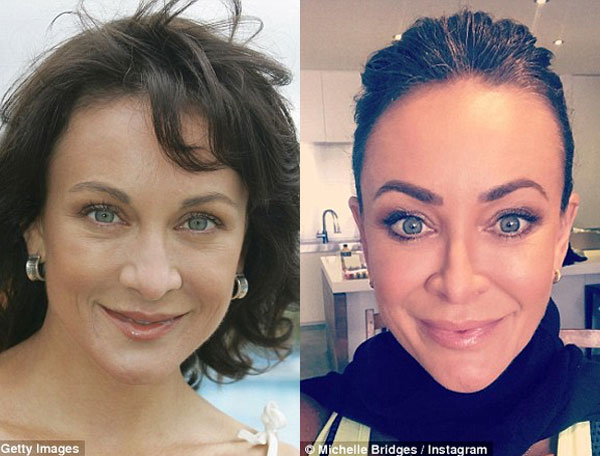 ‘Her eyebrows are a tad too elevated into a pointed arch similar to Captain Spock, which is most likely the result of Botox. Ironically, this shape can be softened with a further small shot of Botox above each arch. I have a small suspicion Botox was also injected in and around her chin because her smile in recent pictures seems somewhat restricted and stiff,’ he explained.