I have been using Botox™ for close to 16 years now and have successfully applied it to not only erase forehead and eye region wrinkles, but also to improve the oral area and neck. By strategically injecting small amounts of Botox™ into the upper lip I can help curl out the upper lip by emphasizing the “white roll” or vermillion border as well as soften the stubborn wrinkles there. Also I can elevate the otherwise sad, downturned corners of the mouth by injecting into the depressor anguli oris muscle (DAO) and produce a minor facelift by injecting the platysma muscle of the neck.
The chin can also by smoothed out by ridding it of that aging cobblestone appearance when grimacing, while pore size can be reduced by selectively placing Botox™ into the dermis of the skin only. With this latter technique (when injected into the forehead), the patient can still move their brows but their wrinkles are vastly reduced as well as their pore size- that frozen look is avoided which is especially important for my actor patients. Xeomen™ is a new substitute for Botox and has a number of advantages.
For further information, check out these Extra™ LifeChanger features on the very subject:
Tag: Dr Randal Haworth
The Injectable Nosejob
In the era of Twitter, Facebook, texting, rapid- fire music video editing, etc. everyone (including those not diagnosed with ADD) wants instant results. So what is unusual with wanting an instant nose job or rhinoplasty? Absolutely nothing. An instant nosejob is performed by strategically injecting a pre-chosen filler just below the nasal skin in an aesthetically sensitive manner. Temporary fillers such as Hyaluronic acids (Restylane™, Perlane™, Juvederm™, etc.) and calcium hydroxyappatite (Radiesse™) may be used as a “dress rehearsal” to confirm if the patients like their result. If so, many will then opt for a more permanent filler, either in the form of fat, Artefil ™ or Aquamid ™ (which is not yet FDA approved).
The appeal is obvious: less bruising, less prolonged swelling, less initial expense, less scary for the wary and more predictable (in the proper hands) with less risks. However, the injectable technique cannot be used to correct all types of cosmetic nasal problems and deformities. This is especially true for noses that need to be reduced in size and refined in shape. One does not need to be a genius to realize that fillers may do little to make a nose smaller by removing humps, refining tips and narrowing bones, no matter how well injected they are. The ideal candidate for an injectable rhinoplasty is the nose that needs to be augmented, either via it’s bridge (or dorsum) or it’s tip or both. A drooping tip can be elevated only to a subtle degree with filler.
Filler is also a great solution to those noses that have minor irregularities stemming from prior rhinoplasties. Filler will generally not help breathing problems. To learn more about this elegant solution to a rather common problem, check out these videos:
1.Extra Injectable NoseJob
2.Today Show Injectable NoseJob
3.Extra Artefill Injectable revision rhinoplasty
Dr Randal Haworth of Beverly Hills counts primary and revision rhinoplasty as one of his specialties of plastic surgery
The appeal is obvious: less bruising, less prolonged swelling, less initial expense, less scary for the wary and more predictable (in the proper hands) with less risks. However, the injectable technique cannot be used to correct all types of cosmetic nasal problems and deformities. This is especially true for noses that need to be reduced in size and refined in shape. One does not need to be a genius to realize that fillers may do little to make a nose smaller by removing humps, refining tips and narrowing bones, no matter how well injected they are. The ideal candidate for an injectable rhinoplasty is the nose that needs to be augmented, either via it’s bridge (or dorsum) or it’s tip or both. A drooping tip can be elevated only to a subtle degree with filler.
Filler is also a great solution to those noses that have minor irregularities stemming from prior rhinoplasties. Filler will generally not help breathing problems. To learn more about this elegant solution to a rather common problem, check out these videos:
1.Extra Injectable NoseJob
2.Today Show Injectable NoseJob
3.Extra Artefill Injectable revision rhinoplasty
Dr Randal Haworth of Beverly Hills counts primary and revision rhinoplasty as one of his specialties of plastic surgery
The pinched nose; the rhinoplasty gone “wrong”
Everyone undergoing elective cosmetic surgery truly expects their results to be exemplary and rarely contemplate what they will do if something does not turn out as they expected. Rhinoplasty, or nose job surgery, is one of the most challenging sub specialties in aesthetic plastic surgery and Dr Randal Haworth is one of the leading specialists in revision rhinoplasty. Despite the fact that the nasal area is generally less than 2″ x 1″ x 1 ” in dimension, a small amount of unpredictability always exists in terms of obtaining the “perfect result”. Of course, the more experienced and better the nasal surgeon is, the more he or she is able to harness that unpredictability and secure an excellent result.
Among the more common complications that occur from a rhinoplasty are asymmetry, difficulty breathing, incompetent internal nasal valves (inverted V deformity) and a pinched tip. Modern rhinoplasty techniques involve far more subtle maneuvers than old-fashioned cutting out cartilage and breaking bones. Since the shape of the nasal tip is determined both by skin thickness and the underlying shape of the nasal cartilages, it used to be taught that to avoid a pinched nasal tip, all the surgeon has to do is avoid cutting out too much cartilage. Otherwise, the nostrils will loose the supportive function of the cartridges and collapse upon themselves thus leading to a “pinch tip” appearance. In actuality, the situation is more complicated than that. While it is indeed important to leave enough catilage as support, modern techniques of rhinoplasty involve delicately placing precise sutures in order to control the tip and projection of the nasal tip. If the knots are tied ever so slightly tighter than normal, the supportive nature of the cartilage may be overcome by the scar tissue that will develop in the postoperative period. The cartilages will then become concave in appearance thus leading to a pinched tip as seen in the accompanying photo.
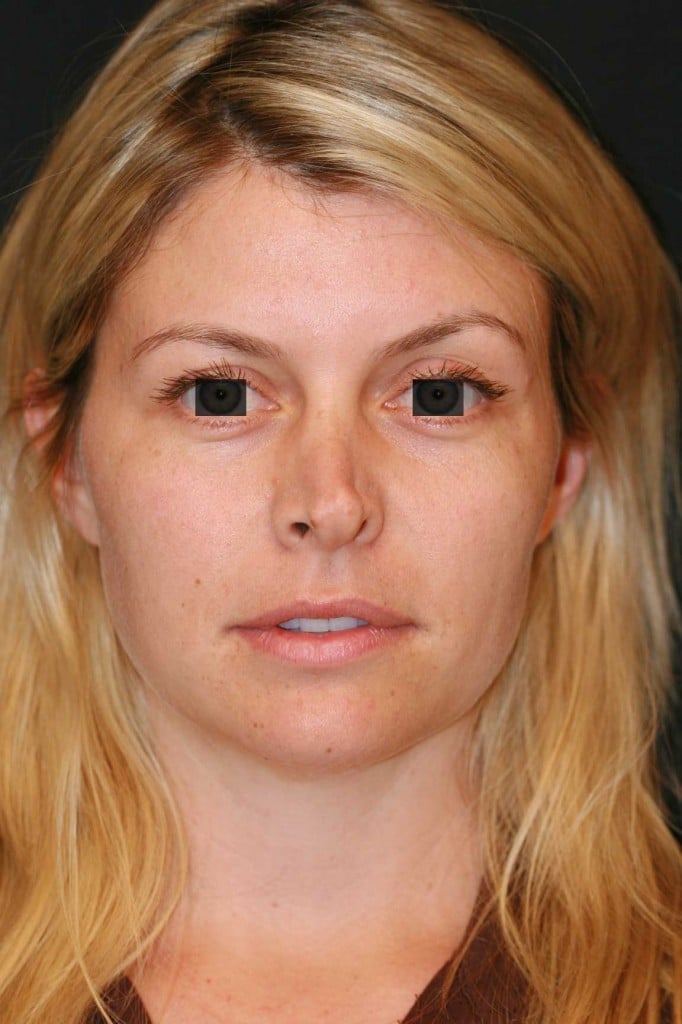
Preoperative nasal deformity after previous rhinoplasty. Note inverted “V” deformity, asymmetry and pinched tip
Also seen in this photo is an inverted “V” deformity. This occurs when the upper lateral cartridges separate away from the midline septum as well as the upper nasal bones. This results in an irregularly appearing nose along its bridge on full frontal view including an altered brow-tip curvilinear line.
Both a pinch tip and an inverted “V” deformity can result in difficulty breathing through the nose. Correction as part of a revision rhinoplasty involves carefully separating the cartilage from the surrounding scar (which may appear deceptively similar in texture and look during surgery) and carefully placing precisely defined cartilage grafts on to the pre-existing weakened cartilage as support. Spreader grafts are needed to correct an inverted “V” deformity. These are small strips of cartilage fashioned from either the septum or ear which are secured between the midline septum and the inner border of the upper lateral cartilage is-in effect, reconstructing the middle vault up the nose. If this remains uncorrected, not only does the visual deformity processed, but nasal obstruction will also occur upon inspiration. This occurs in a similar fashion to a loose canvas roof of a tent which gets sucked in by high mountain winds.
The postoperative photo of the same patient clearly demonstrates the correction of the pinched tip and inverted “V” deformity via cartilage placement, scar removal and judicious fracture of the nasal bones. I also be rotated the tip in order to make the nose look “less done”.
To cut a long story short, added support in the form of cartilage is needed to correct the weakness in the form and function resulting from a rhinoplasty gone awry. Rhinoplasty is similar to a chess game. It is the only surgery that takes me longer to perform than I did 10 years ago. This is because I recognize and deal with any potential pitfalls that may result during the initial surgery. I have to think several steps ahead similar to a game of chess. Finally, not only do I have to make the nose look beautiful, but I have to erase all evidence that anything had been performed by a human hand. this takes time, aesthetic sensibility and patience.
This video shows how a pinched tip can be successfully repaired:
For further information about what one may expect after a rhinoplasty click here
For further information go to www.drhaworth.com or call his office in Beverly Hills to schedule a consultation.
Among the more common complications that occur from a rhinoplasty are asymmetry, difficulty breathing, incompetent internal nasal valves (inverted V deformity) and a pinched tip. Modern rhinoplasty techniques involve far more subtle maneuvers than old-fashioned cutting out cartilage and breaking bones. Since the shape of the nasal tip is determined both by skin thickness and the underlying shape of the nasal cartilages, it used to be taught that to avoid a pinched nasal tip, all the surgeon has to do is avoid cutting out too much cartilage. Otherwise, the nostrils will loose the supportive function of the cartridges and collapse upon themselves thus leading to a “pinch tip” appearance. In actuality, the situation is more complicated than that. While it is indeed important to leave enough catilage as support, modern techniques of rhinoplasty involve delicately placing precise sutures in order to control the tip and projection of the nasal tip. If the knots are tied ever so slightly tighter than normal, the supportive nature of the cartilage may be overcome by the scar tissue that will develop in the postoperative period. The cartilages will then become concave in appearance thus leading to a pinched tip as seen in the accompanying photo.
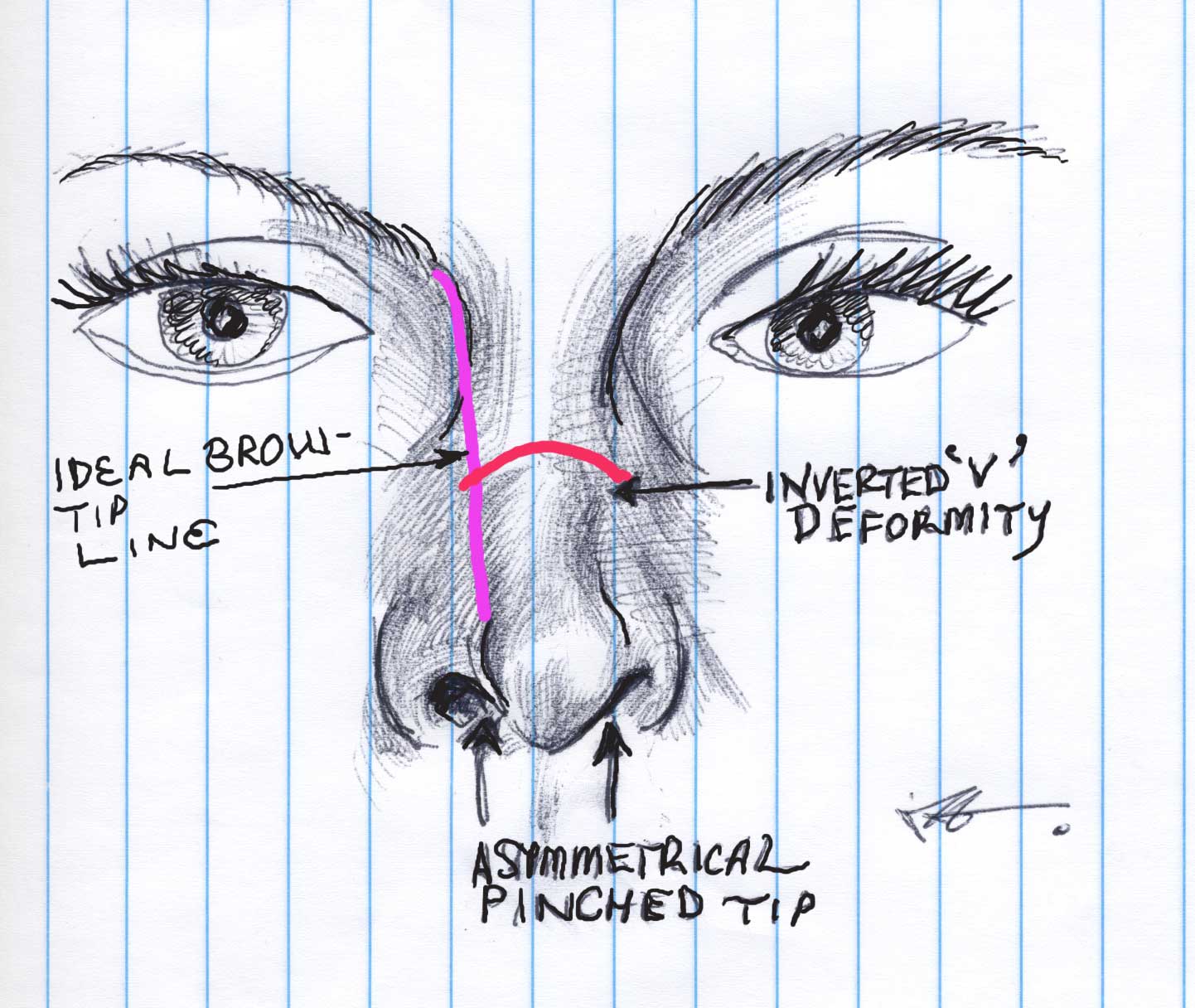
Diagram showing severe nasal deformity after a previous nosejob
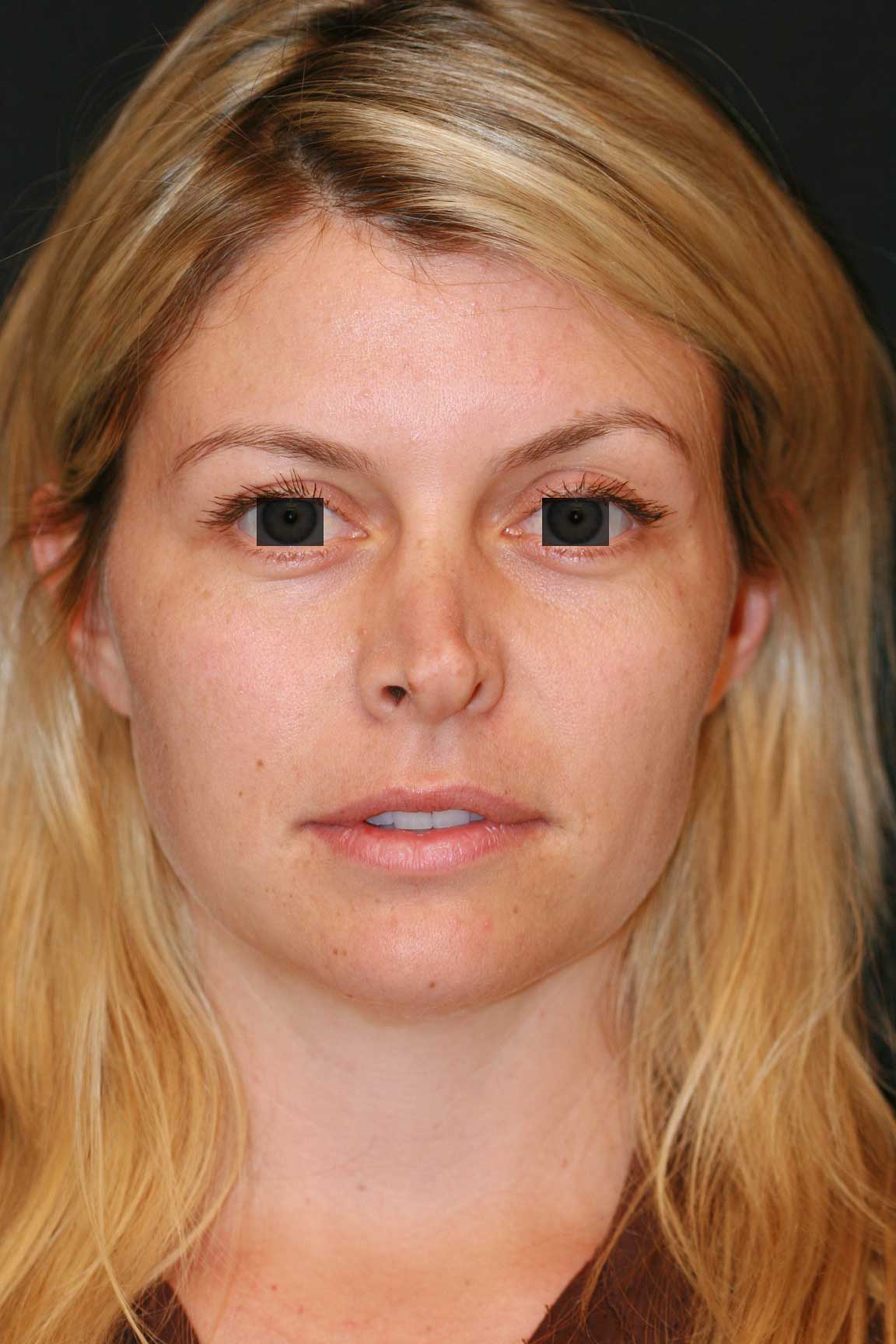
Preoperative nasal deformity after previous rhinoplasty. Note inverted “V” deformity, asymmetry and pinched tip
Also seen in this photo is an inverted “V” deformity. This occurs when the upper lateral cartridges separate away from the midline septum as well as the upper nasal bones. This results in an irregularly appearing nose along its bridge on full frontal view including an altered brow-tip curvilinear line.
Both a pinch tip and an inverted “V” deformity can result in difficulty breathing through the nose. Correction as part of a revision rhinoplasty involves carefully separating the cartilage from the surrounding scar (which may appear deceptively similar in texture and look during surgery) and carefully placing precisely defined cartilage grafts on to the pre-existing weakened cartilage as support. Spreader grafts are needed to correct an inverted “V” deformity. These are small strips of cartilage fashioned from either the septum or ear which are secured between the midline septum and the inner border of the upper lateral cartilage is-in effect, reconstructing the middle vault up the nose. If this remains uncorrected, not only does the visual deformity processed, but nasal obstruction will also occur upon inspiration. This occurs in a similar fashion to a loose canvas roof of a tent which gets sucked in by high mountain winds.
The postoperative photo of the same patient clearly demonstrates the correction of the pinched tip and inverted “V” deformity via cartilage placement, scar removal and judicious fracture of the nasal bones. I also be rotated the tip in order to make the nose look “less done”.
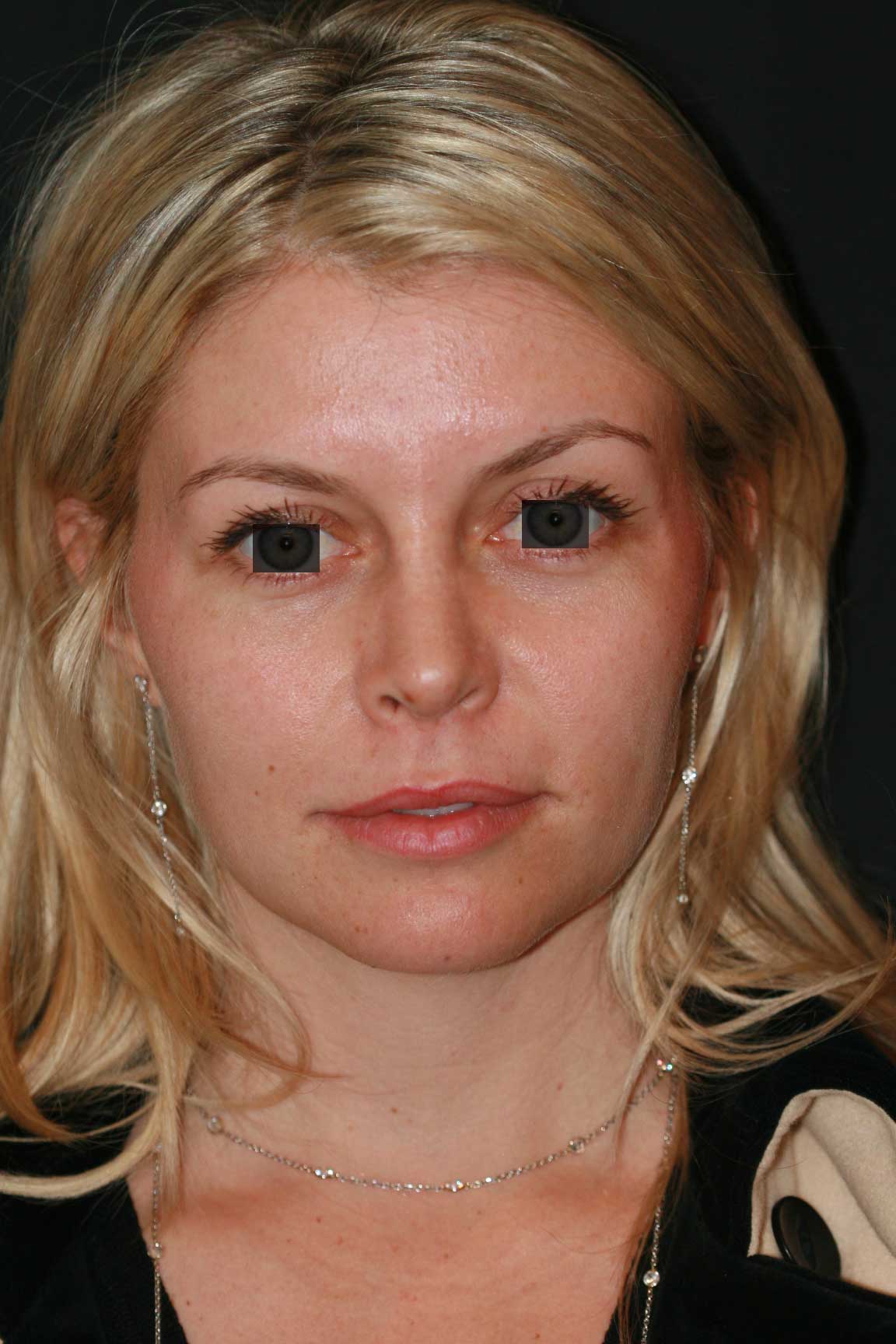
After revision rhinoplasty by Dr Haworth, including placement of spreader and lateral crural strut grafts
This video shows how a pinched tip can be successfully repaired:
For further information about what one may expect after a rhinoplasty click here
For further information go to www.drhaworth.com or call his office in Beverly Hills to schedule a consultation.
Rhinoplasty Philosophy – Dr. Randal Haworth
Rhinoplasty, or what people refer to in colloquial parlance as “nose job” surgery, is one of my favorite specialities. I have performed literally thousands of these challenging procedures as far afield as the Middle East, Europe and South East Asia. What I find so fascinating about rhinoplasty is how it can impart such dramatically positive change to the face as a whole – a classic case of the final result being greater than the sum of it’s parts.
Not only do I find it immensely gratifying to invent new solutions to challenging problems, I actually like the ” feel” of the surgery- the intricate interplay between skin, cartilage and bone. Even after 16 years of private practice, I discover new, exciting nuances in techniques that the average surgeon performs without feeling. Though I considered myself “top of my game” at the time I was doing plastic surgery on ” The Swan” in 2004, I look back upon those patients today and realize I could do better on a third of those rhinoplasties I performed! Like an artist, I always aim to do better and realize that my work today is better than it was in 2004 and will be better still 5 years from now, barring some personal tragedy.
The first era for me in rhinoplasty surgery was about creating beauty and my second era is about controlling beauty- imbuing a subtle softness into the result, and erasing all signs that humans hands had anything to do with the patient”s nose. A good pianists doesn’t just play the notes and chords accurately but also with crescendo and pianissimo- with feeling. My next series of blog posts will revolve around the subject of nasal surgery and aim to share with you certain concepts, both basic and advanced, that are important to both the lay person and surgeon alike.
Dr Randal Haworth of Beverly Hills is a specialist in all forms of aesthetic plastic surgery including primary and revision rhinoplasty.For further information go to drhaworth.com
Not only do I find it immensely gratifying to invent new solutions to challenging problems, I actually like the ” feel” of the surgery- the intricate interplay between skin, cartilage and bone. Even after 16 years of private practice, I discover new, exciting nuances in techniques that the average surgeon performs without feeling. Though I considered myself “top of my game” at the time I was doing plastic surgery on ” The Swan” in 2004, I look back upon those patients today and realize I could do better on a third of those rhinoplasties I performed! Like an artist, I always aim to do better and realize that my work today is better than it was in 2004 and will be better still 5 years from now, barring some personal tragedy.
The first era for me in rhinoplasty surgery was about creating beauty and my second era is about controlling beauty- imbuing a subtle softness into the result, and erasing all signs that humans hands had anything to do with the patient”s nose. A good pianists doesn’t just play the notes and chords accurately but also with crescendo and pianissimo- with feeling. My next series of blog posts will revolve around the subject of nasal surgery and aim to share with you certain concepts, both basic and advanced, that are important to both the lay person and surgeon alike.
Dr Randal Haworth of Beverly Hills is a specialist in all forms of aesthetic plastic surgery including primary and revision rhinoplasty.For further information go to drhaworth.com